

Self-generation as the key to lower charging costs
Especially with depot charging, companies have the opportunity to actively shape their energy supply. Large roofs of logistics centers, warehouses, or commercial buildings often offer ideal conditions for self-generated electricity using photovoltaics.
If the generated solar power is used directly to charge vehicles, the amount of electricity drawn from the public grid is reduced. This makes the company’s own PV system a key component in optimizing the ongoing energy costs of the electric fleet in the long term.
The key is not to view the dimensioning of the system in isolation, but to coordinate PV generation, existing site consumption, and future charging requirements.
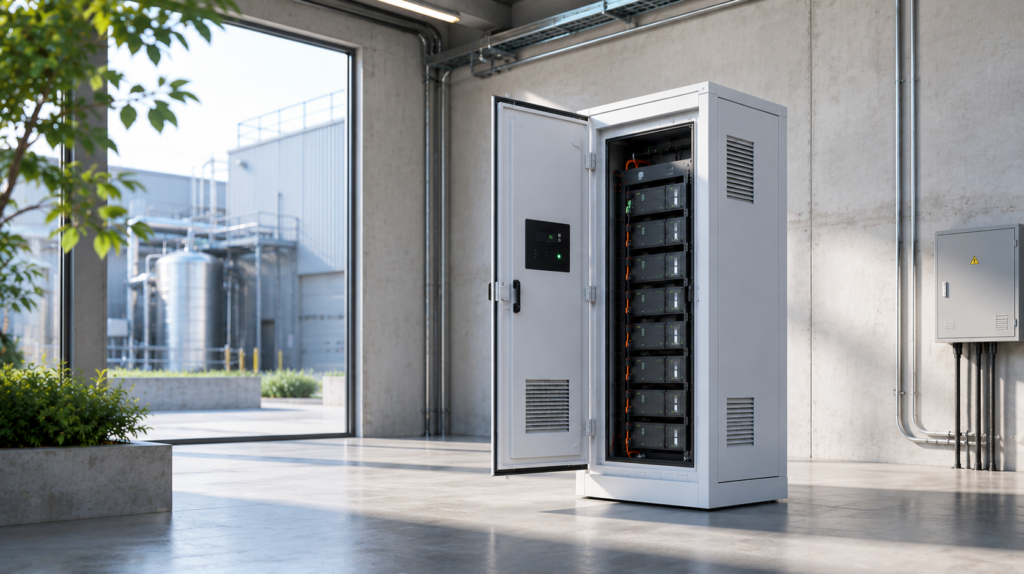
Battery storage creates flexibility during charging
However, photovoltaic generation and charging demand do not always occur at the same time. Many trucks only return to the depot in the evening – when PV generation is already significantly decreasing.
Battery storage systems can temporarily store energy generated during the day and make it available at a later time. This allows self-generated solar power to be used, for example, for charging during evening and night hours.
At the same time, battery storage can help to smooth out high peak loads when charging several vehicles simultaneously. In combination with intelligent load and charge management, the available power is distributed specifically to vehicles and the rest of the site’s consumption.
The depot as a holistic energy system
The economic implementation of eTrucking therefore does not start at the individual charging point. Rather, it is necessary to consider the entire energy system of the site:
How many vehicles are to be charged? When are they at the depot? What charging power is actually required? What grid connection capacity is available? And what contribution can photovoltaics and battery storage make?
These factors result in an energy concept in which generation and consumption interact as optimally as possible.
Plan eTrucking economically with Volturo
Volturo supports companies holistically on the path to an electrified fleet. We first analyze whether and under what conditions eTrucking can be technically and economically implemented at the respective site.
Based on this, we plan and implement the necessary charging infrastructure as well as photovoltaic and battery storage systems and tailor the individual components specifically to the site’s energy requirements.
In this way, individual technologies become an intelligent overall system – with the goal of reducing charging costs, avoiding peak loads, and using the available energy as efficiently as possible.
Would you like to know how eTrucking can be implemented economically at your site?
→ Analyze your site now and plan depot charging holistically.